Ingredients:
1 lb. boneless and skinless chicken breast (ground)
3 dehydrated shitake mushrooms (soaked in moderately hot water until supple, eliminate arises and cut up delicately)
3 cloves garlic (cut up delicately)
2 new water chestnuts (chopped delicately)
2 tablespoons preparing food oil
Marinade:
1 tablespoon soy dressing
1 tablespoon oyster dressing
1/2 teaspoon kecap manis (sweet soy dressing) or dark soy dressing (for tinting)
1/4 teaspoon salt or to flavour
1 tablespoon Shaoxing wine
1/2 teaspoon sugar
1 teaspoon maize starch
1 stalk scallion (finely cut up)
3 dashes white pepper dust
1 fresh and cold iceberg lettuce head
Hoisin-Ponzu dropping dressing:
3 tablespoons hoisin dressing
1 tablespoon Japanese ponzu sauce
1/2 teaspoon Sriracha chili sauce
1 tablespoon moderately hot water (to dilute the dropping dressing)
sugary Chili Sauce:
4 tablespoons Mae Ploy sweet chili sauce
Some cilantro departs (chopped)
1/2 tablespoon lime juice extract extract extract extract
procedure:
blend the ground pullet beef, cut up mushrooms and water chestnuts with all the marinate components. Set apart for 15 minutes.
blend
the dipping sauces and set apart. Heat up a wok and add the cooking
oil. Saute the garlic until light dark and then add the chicken.
Stir-fry the ground chicken and shatter up the chunks so they form
pleasant little pieces. extend to stir-fry until the chicken is prepared
food. Dish out and set apart.
mindfully peel off the lettuce
departs from the iceberg lettuce head. Be very cautious not to shatter
the departs. Scoop up a large-scale spoonsful of chicken and location it
in the middle of a lettuce leaf. cover it up and dip into the
hoisin-ponzu dressing or sugary chili dressing before eating.
Alternatively, you can add the sauce on peak of the chicken before
eating.
Easy Chinese Recipes & repasts
What makes a recipe very simple? Some, like stir-fries, take only
minutes to make. other ones, such as broths and stews, take longer but
still comprise of only a couple of simple steps, departing you many of
free time while the nourishment is simmering. numerous Chinese recipes
are quick, easy to make, or both. Some can be made with components that
are available at most localizedized shopping centres, while others may
need a journey to a Chinese/Asian market or using a alternate. if you're
new to Chinese preparing food or just looking for a recipe that doesn't
need expending too much time in the kitchen, here are a number of
recipe concepts.
General Tso's Chicken
Why would a blog dedicated to "Traditional Chinese Recipes" feature General Tao's Chicken, a dish virtually unknown in China? For one thing, one of the minimal definitions of tradition is "an artistic or literary method or style established by an artist, writer, or movement, and subsequently followed by others." General Tso's certainly qualifies on that basis, since this dish is served everywhere in the world by Chinese chefs in Chinese restaurants--everywhere, in fact, except China, and with some surprising degree of consistency. Further, if we think of the mainland as the "go to" authority, consider that General Tso's Chicken was invented in China, by a Chinese chef, and while it faded from view in Mainland China, it made its way from there to Taipei, to the United States, and evolved, as most traditions do, to become the famous dish we know today. (I'd venture to say this may all be a moot point anyway, since the ever-wealthier China absorbs so many cultural trends of the West, so the worldwide popularity of General Tso's Chicken will someday make it as much a traditional dish in China as it is here.)
The history of this dish has been thoroughly described by at least two authors. Fuchsia Dunlop gives an excellent account, and a recipe for the unsweetened Hunanese version, originated by chef Peng Chang-kuei, in her excellent book, Revolutionary Chinese Cookbook. Similarly, Jennifer 8. Lee describes with delicious humor her search for the original General Tso's Chicken in The Fortune Cookie Chronicles.
The attraction of this dish is doubtless in its simplicity of flavor and texture-- the chicken is chewy/crisp on the outside, moist on the inside, all drenched in a dark, spicy, sweet and tangy sauce. The secret to a chewy/crisp exterior is double frying, utilized by Chinese chefs in a number of dishes where crispness of an otherwise moist item is desired.
1 1/4 lb boneless chicken thigh
1 heap Tablespoon minced garlic
1 Tablespoon minced ginger
2 Green onions
4 - 6 chilis, cut into 3/4" lengths (Optional)
Chicken Marinade:
1 tsp dark soy
1 Tab light soy
1 Tab Shao Xing wine or dry sherry
1 Tab cornstarch
1 egg white
Batter:
In a bowl, appx 2/3 cup cornstarch
1/2 tsp baking soda. (The baking soda assists with the Maillard browning reaction which cornstarch is otherwise resistant to)
Sauce:
3/4 cup chicken stock
1 1/2 Tab sugar
1 heap tsp brown sugar
1 TAB rice vinegar
2 TAB light soy
1 tsp dark soy
1 Tab rice wine
Cornstarch slurry (see thickening sauces in Technique)
Sesame oil, slivered red pepper or carrot for garnish
The following can be done ahead of time: wash and trim out tendon and large fat deposits from chicken thigh pieces and cut into chunks approximately 2" square or so. Dry the cut meat; in a bowl, mix very thoroughly with the marinade to evenly coat. In another med large bowl, combine cornstarch and soda and set aside.
Preheat deep fryer to 375º to prepare for the first frying.
Dredge marinated chicken pieces in the cornstarch/soda mixture and shake off extra coating, setting aside these aside until all the chicken is battered. Lower pieces carefully into the 375º oil. Fry approximately 3 minutes, stirring occasionally. Remove to a platter with paper towels or drain rack, separate, and allow to cool.
Meanwhile, mince garlic and ginger. Mince the white portion of the green onion, and chop the green portion separately into 1/8" rings. Prepare the sauce, set aside in a bowl, and prepare cornstarch slurry.
When the fried chicken pieces are completely cool to the touch, you are ready for the 2nd frying, but first you'll make the sauce. As the deep fry oil heats to 375º, heat a wok on med/high, swirl in 2 Tab of peanut oil, and when the oil is hot, add the minced ginger, garlic and onion and stir fry a few seconds. Add the chilies, if using, and then splash in the tablespoon of wine. Add the sauce mixture, and as soon as it begins to boil, slowly add cornstarch slurry while stirring ingredients until the sauce thickens to the desired consistency. If using an electric stove, take the wok off the heat until the burner cools to low before returning; the sauce should remain in the wok on a very low heat while the chicken is fried a second time.
With the deep fry oil at 375º carefully lower the chicken into the oil and cook for another 3 or 4 minutes. Remove with skimmer or bamboo strainer, gently shake off excess oil, and place directly into sauce. This may require two or three dips into the oil. Now toss the chicken in the hot sauce, remove to a serving platter and garnish with sesame oil, green onion shreds, or other garnish.
Chive and Prawn Dumpling
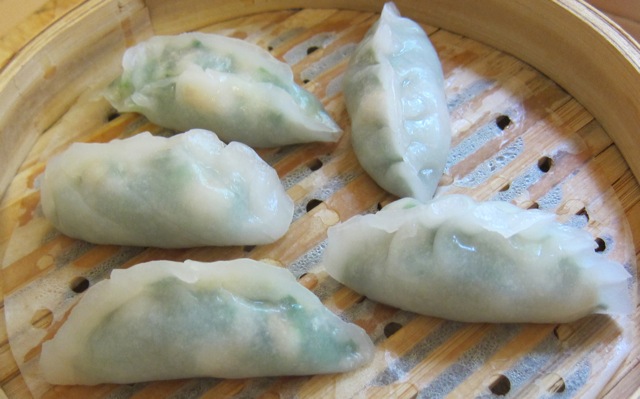
Here is another delicious mainstay of the tea ritual known as dim sum, and belongs to the class of dumplings enfolded with a wheat starch wrapper. The name in Cantonese is Gao Choi Ha Gao 韭菜虾饺, or simply Gao Choi Gau (In Mandarin, Jiu Cai xia Bao). You will find this steamed dumpling in almost every dim sum restaurant, although it will sometimes be formed into hockey-puck sized packets, and fried. In either case you'll know it by the intensely green vegetable showing through the translucent wrapper.
Like cilantro, Chinese garlic chives, jiu cai might strike some as an acquired taste. Once accustomed to its sharp and fragrant flavor, however, it becomes an essential sensation for lovers of dim sum.
Filling:
12 oz prawn, peeled and deveined
12 oz garlic chives
1 egg white
2 med clove garlic, minced
1/4 rounded tsp white pepper
2 rounded tsp cornstarch
1 Tablespoon plus 1 tsp Shao Xing wine
1 tsp sesame oil
1 rounded tsp sugar
1 tsp salt
Wrapper:
1 Cup wheat starch
1/2 Cup tapioca Starch
1 Tab Peanut oil
1/4 tsp salt
1 Cup boiling water
Dice half the prawns fine (appx 1/8"), and the other half large (appx 1/2") and set aside in a mixing bowl. Garlic chives are sold in bundles at Chinese groceries, and known by the names jiu cai (Mandarin), and gao choi (Cantonese); cut off 1 or 2 inches of the thickest (root) end, then chop into 1/2" sections. On med heat, Stir fry in a wok or sauté pan until wilted, about a minute. Allow to cool before adding to the prawns.
After adding the cooled chives to prawn, combine the remaining filling ingredients and mix very thoroughly with a rubber spatula. Refrigerate.
Sift the starches and salt into a mixing bowl; form a well in the powders, then add the oil. Pour the boiling water, measured with a pre-heated measuring cup, into the well and stir quickly but carefully with a rubber spatula. Scrape the sides as you mix, to incorporate all the ingredients. Form a ball of dough. As soon as you can handle the dough, knead it vigorously for a full 3 minutes, occasionally compressing the ball forcefully as you knead. (Wheat starch dough is firm to the gentle touch, but extremely malleable). This enthusiastic kneading is to insure that the starches and water and oil are smoothly and completely incorporated. Divide the dough into 3 pieces and let it rest in a plastic bag for 10 minutes or so. All the foregoing steps can be done ahead of time.
When ready to make dumplings, prepare your steamer with a parchment paper liner for the steamer tray—punch or cut 1/4” holes randomly in the paper to allow steam to pass through. Alternatively, liberally oil the steamer tray or use vegetable leaf to ensure the wheat starch wrapper does not stick after steaming. Allow the steamer water to boil, with the basket separate, ready to load dumplings.
Compress each ball of starch into a smooth, round shape and then roll on a flat surface to make a 1” dia. Rope. Put two ropes back in the plastic bag and cut the remaining into 1” segments. To make the skins: working on a high density polyethylene cutting board, place a piece of 4” square piece of parchment paper over the segment and flatten it one at a time with rolling pin, Chinese cleaver, or tortilla press (works great), making sure the skin is a uniform thickness of between 1/16” and 1/8". This disk will be slightly irregular in shape; you can proceed with making the dumplings and trim the excess with scissors if necessary, or cut the skin now to appx. 3-3/4"diam. (Traditionally, Gao Choi Gau is much larger than Ha Gau, which uses a circle 3-1/4" or less--) Use a cookie cutter, empty tin can or similar round object . You can make the skins all at once, if they are kept covered with plastic or damp cloth at room temperature. The procedure for stuffing the dumplings can be the same as for pot stickers, but note that wheat starch dough is very delicate, and care must be taken not to puncture or tear the skins while filling. (Dim Sum chefs occasionally vary the pleat design of dumplings, and you may want to experiment with your own method).
Place the dumplings in the lined steamer tray, but do not allow them to touch each other. Put over the steamer, and cook for 6 to 7 minutes. Serve in the steamer or place on a serving dish when cool enough to handle. An accompanying dipping sauce is a nice touch, as is tea.
Beef Chow Fun
Gōn cháau ngàuh hó (Cantonese) 干炒牛河 (Mandarin: Gān Chǎo Níu Hé)
Beef Chow Fun has appeared on Chinese menus here and on the mainland almost as long as there has been restaurants. In spite of this, searching for consistent chow fun recipes is a daunting task. On the internet, there are as many versions as there are sites, the best being Andrea Nguyen's. Published cookbook literature by Chinese authors are nearly as varied. The recipe presented here is the one you'll encounter most often in Hong Kong (a city that rules the roost for Southern Chinese cuisine), and at Dim Sum restaurants, either as "special" item on one of the roving carts, or a menu item traditionally ordered along with the small snacks of dim sum.
Dry rice noodle can be used with acceptable results, but it is highly recommended that you buy fresh rice noodles (Cantonese: ho fun; Mandarin: he fen)these should be available if you live in an area that has a sizable Asian community and grocery stores serving that community. But fresh rice noodles are literally a delicacy: make sure you can purchase them unrefrigerated, or fresh from a noodle maker. Otherwise, the cold ho fun will often be so stiff and compact, you will not be able to separate the noodles. Moreover, it's a good idea to use the noodles as soon as they are purchased. I bought a few pounds of ho fun from a producer on Friday, and by Sunday they were beginning to break down.
Other than the challenges of the noodle, Beef Chow Fun is easy to make, and works well in a vegetarian version, omitting the beef.
1 lb Fresh rice noodles (ho fun, at least 1/2" wide
7 oz Beef Tri Tip, sliced 1/8" thick across the grain, appx 2" x 2 1/2"
1/2 Lb. bean sprouts
2 tsp fermented black beans, minced
2 lg cloves garlic, minced
1" x 1" pc ginger, minced
3 - 4 green onion, cut into 2" sections, white portion split lengthwise
3/4 small or 1/2 med yellow onion
4 Tab peanut or cooking oil
Meat Marinade:
1 Tab soy
2 Tab rice wine
1 round tsp Bicarbonate of Soda
2 tsp cornstarch
Sauce:
2 Tab Soy light
2 tsp dark soy
1 Tab Rice wine
1/2 rounded tsp salt (or to taste)
1 round tsp sugar
Sesame oil and a spring or two of cilantro for garnish
Marinate the meat for at least a few hours; overnight is even better. Carefully separate the strands of ho fun and set them aside lightly covered with film or damp towel.
On high heat, with 2 Tablespoon of oil, add garlic, ginger, and both kinds of onion; toss a couple of times, then press onion to the wok to facilitate browning. After half a minute or so, turn the onions and garlic/ginger over and press gently again. As soon as you observe browning on the onion, move the mixture to the side of the wok.
Add a tablespoon more oil, allow to heat, then add the beef slices. Separate the slices with a pair of chopsticks or with the wok shovel and press this gently to the bottom. When the meat is browned, stir fry everything for a few seconds, until the meat is barely cooked. Immediately remove to a platter.
Wash wok, reheat on medium high, and swirl in the remaining tablespoon of cooking oil. When the oil just begins to smoke, add the rice noodles in a layer and gently press them to the wok. In about a minute, when they begin to brown, flip the noodles over and repeat the procedure. Add bean sprouts, gently stir fry for a few seconds, then add all other ingredients, including the sauce, and gently but quickly stir fry and mix the ingredients to combine and heat through.
Pile on a serving platter and garnish with a little sesame oil, cilantro and slivers of red pepper
Hong Shao Rou
Hong Shao Rou Red Braised Pork
Little known outside the Asian Community, Hong Shao Rou, (红烧肉) literally, red braised pork, is succulent morsels of pork belly simmered in an aromatic, rich soy-based broth until tender. I first experienced this dish in Macao, where the softened, anise-infused pork was nothing short of a revelation. Hong Shao Rou belongs to a class of very traditional Asian dishes known as red cooking, which employs a range of ingredients, including beef, chicken, vegetables and dou fu (See Fuscia Dunlop's excellent red cooked recipes in her Revolutionary Chinese Cookbook).
Recently, the dish has gained some cache on the Mainland because it is known to be one of the late Chairman Mao's favorite dishes, and according to an article in the Xiaoxiang Morning Herald, he considered it "brainfood." (see Malcom Moore's article),
Since the unctuous pork belly has weaseled its way into the Western fine dining scene, Red Cooked Pork should find an enthusiastic audience in the U.S.; however, one will rarely see Hong Shao Rou offered at stateside Chinese restaurants. This is a bit baffling, since it is very easy to make, and irresistibly tasty.
2 lbs pork belly, lean and fat, skin on, cut into sections approx 4" x 4"
3 round Tab sugar
3 cups chicken stock, low sodium
2 - 2" x 1/4" pc cinnamon
2 star anise
2 cloves garlic, smashed
3 1" x 2" slices of ginger, skin on.
1/3 cup soy
1/4 cup Shao Xing wine or dry sherry
1 TAB dark soy
In enough water to just cover the pork, poach belly in simmering water (“cuan” 汆) for 4 minutes or so, then remove. When the pork has cooled enough to handle, cut into cubes appx. 1 1/2" x 2" and in two batches, brown in a hot wok or cast iron skillet with 3 or 4 Tab peanut oil or lard. Be careful, this entails lots of spattering…Remove and set aside. In the same pan, on med heat, add the sugar and stir until melted and beginning to caramelize. Add back in the pork belly pieces, and toss until coated and further browned with caramelized sugar.
Transfer the pork and residual oil/sugar mixture to a 3 -4 quart sand pot or sauce pan; add the chicken stock to cover pork pieces, cinnamon, star anise, garlic, ginger, light soy, wine, and dark soy. Bring to a gentle boil, and simmer for approximately 1 hour, until pork lean layers are tender but still moist. As soon as meat is done, remove meat and boil to reduce sauce. When liquid has reduced to desired consistency, turn off heat. Return pork belly to the pot and mix to coat; serve in sandpot or plate with garnish of cilantro and carrot or red pepper slivers
Suan La Tang
Suan La Tang (literally, "sour hot soup," but known in the West as Hot and Sour Soup)
A riot of flavor and texture, this is the soup your grandmother might make, if your grandmother was Chinese and lived in Northwestern China--the eastern equivalent to "vegetable soup." And so, you will find a great deal of variation in the ingredients for this healthful dish. Some published recipes will include such additions as duck blood and sea cucumber. But, like General Tso's Chicken, which began in Asia as a very different animal, this dish has adapted to Western tastes, and has now evolved it's own traditional preparation in Western Chinese restaurants, especially those billing themselves as regional or Sichuan restaurants.
1 cup cilantro leaves, no stems
GARNISH:
A few cilantro leaves
But even if one ignores the foregoing the sea cucumber and duck blood, Suan La Tang still has ingredients that are unfamiliar to most western cooks: "Cloud Ear Fungus" (云耳; yún'ěr,) and "Golden Needles." huang hua cai 黃花菜. These inclusions have as much to do with texture as flavor, as you will see, but along with bamboo shoots and Chinese dried mushroom, they are essential to the character of Suan La Tang.
Finally, this recipe is not for the faint of heart. Hot and Sour Soup is not technically difficult to make, but to be honest, it is time consuming. Each of the eight main ingredients need at least two stages of prep; soaking, marinating, then carefully slicing and shredding. But, as with most things in life, the difficulty pays off, and the results are far superior to anything you're likely to find in Western Chinese restuarants.
Prepare the following:
4 Chinese dried mushrooms-- soak in 180° hot water for 40 min; wring out moisture when cool, then julienne.
1/4 oz Cloud ears-- soak in 180° hot water for 40 min; wring out moisture when cool, then julienne.
3/4 oz golden needles, soak in 180° hot water for 40 min; wring out moisture when cool, then cut large pcs in half
1 - 2 oz bamboo shoots, blanched, drained and slivered
MARINATE the above in
1 TAB sweet black vinegar
1 TAB wine
1 TAB soy
2 scallions, diagonally sliced
1-2 tsp chopped dried chili or chili flake if desired
6 oz Pork, Partially frozen to stiffen then julienned; marinate in 1 TAB Light Soy, 1 Tab rice wine or sherry
8 oz firm fresh Doufu; Rinsed, matchstick
In a large sauce pan COMBINE stock:
3 cans low sodium chicken stock (1 1/2 quarts--Homemade is best)
1 Heap TAB chx boullion paste or powder
12 oz water
In a bowl, COMBINE:
4 TAB rice vinegar
1 Heap tsp Sugar
1 TAB light Soy
1 TAB Black Soy
1/2 tsp coarse black pepper
1 tsp fine white pepper
In a bowl, COMBINE with whisk:
2 eggs + 2 tsp oil + pinch of salt
COMBINE:
4- 5 TAB potato starch with 4 TAB water for slurry
SET ASIDE:
SET ASIDE:
1 cup cilantro leaves, no stems
GARNISH:
A few cilantro leaves
Sesame oil
Once the preparation of the ingredients is complete, assemble the soup in the following order: Bring the stock to a simmer with the Chinese mushrooms, Cloud ears, golden needles, and bamboo shoots; Lower heat to barely a simmer; Add julienned PORK; Add DOU FU; When the stock begins to simmer again, add potato starch slurry slowly until it thickens per your preference; pour in beaten EGG in a thin stream and do not stir for a half minute or so to set egg; add CILANTRO, then VINEGAR mixture and stir only enough to distribute ingredients. Remove to a serving bowl. Garnish w/ Sesame oil, few pieces of cilantro and chili
Hong Shao Shi Zi Tou (Red Braised Lion's Head)
It is not often you'll find this very traditional dish in stateside Chinese restaurants, yet in China north and south, Shi Zi Tou (Lion's Head) is very common. The poetic name of this dish results from its appearance: large meatballs in a bed of cooked cabbage suggests, with a little imagination, a lion's head surrounded by his mane. Variaions exist, especially in southern China, where Shi Zi Tou may have a lighter broth or sauce, and possibly cellophane noodles (fen si), in addition to the cabbage. The present recipe is a Shanghai version, utilizing the famous "red cooked" (hong shao) method of poaching in soy and stock; if you prefer a lighter, "Southern" variation, you can simply omit the two soy sauces and substitute 4 tablespoons more chicken broth. This recipe also calls for water chestnuts, and it is highly recommended that you buy the fresh ones rather than canned, available at most Chinese groceries, even though it takes a few minutes to peel them. Once you experience the sweet, tender fresh water chestnuts, you'll never go back.
- 1 1/2 lbs Ground Pork
- 4 TABWater
- 8 Water Chestnuts, large mince
- 3 Scallions, minced
- 3 tsp Ginger, minced
- 2 tsp Sesame oil
- 1 TAB Sherry
- 1/2 tsp Salt
- 2 - 3 TAB Cornstarch for dredging pork balls
- 3 or 4 TAB Peanut oil
- 2 TAB Dark Soy
- 2 TAB Light Soy
- 20 oz Napa Cabbage, root end trimmed, leaves separated
- 2 tsp Brown sugar
- 1 1/4 cup Chicken stock (homemade is far superior, see Technique)
Make a potato flour slurry (equal parts water and starch, appx 2/3 tsp each; you can also use cornstarch, though it will not result in as gelatinous a sauce)
Combine pork and water. Mix meat in one direction, and keep mixing until it is somewhat fluffy and cohered, a few minutes; add large mince chestnuts, minced scallion, minced ginger, sesame oil, sherry and salt; mix well and form into 5 large meat balls approx 6 oz each, 2 1/2" to 3" diameter.
Dust meatballs in cornstarch and remove excess--set aside.
Heat wok with 3 TAB peanut oil over medium heat; when wok oil is just barely smoking, add meat balls one at a time and fry, rolling and turning very gently, until slightly firm and browned. Remove.
Clean wok, heat to medium, add 6 Tablespoons of water, put in cabbage leaves, cover and steam 5 minutes or so until leaves are flexible. Remove and allow to cool enough to handle.
Line sand pot (sha guo) or small casserole with 2/3 of the cabbage; gently add the five meatballs, then pour in chicken stock, sugar, and soy sauces. Lay remaining cabbage over meat, cover and braise balls for 1 1/2 hours on top of stove.
When done and cool enough to handle, carefully remove Lion's heads to a plate. On the service platter, arrange braised cabbage in a circular pattern; arrange meatballs in the center. Reduce braising liquid to desired flavor intensity and add stream of slurry until liquid is thickened, coats spoon thickly, but still runs. Pour over Lions head, garnish with slivered green onion or slivered carrot.
Siu Maaih Pork and Shrimp Dim Sum dumpling
Siu Maaih Pork and shrimp dumpling
There is no item that so epitomizes dim sum as this little morsel. It will be served in every dim sum restaurant, no matter how humble the offerings. Its name, Siu Maaih, which literally translated from Cantonese means "cook sell," might describe its humble beginnings as a street snack to go with tea, and therefore may have been dim sum's first dumpling. Luckily for those of us who are willing to slave away in the kitchen making traditional Chinese delicacies, this one is relatively easy to produce. One can make their own skins for siu maai, if one wants to destroy one's kitchen over the course of a very long day, but few cooks try it; the thin, factory made wrapper, available in every Chinese store, is inexpensive and foolproof.
2 small to medium shitake dried mushrooms
11 oz pork (picnic country rib boneless), minced (previously ground pork is acceptable)
6 oz shrimp, after shelling and deveining; 1/3 of this pureed or pounded, 2/3 should be chopped.
1 sm green onion, minced
1 Tab soy
2 tsp sugar
1/2 tsp salt
dash white pepper
3 tablespoons water
1 pkg "thin shao mai" wrapper (i.e., Seattle's Rose brand)
Reconstitute the dried mushroom by submerging in very hot water for 1 hour. Press out water, cut out stems, mince and set aside.
Prepare all other ingredients and combine, including the minced mushroom. Mix vigorously in one direction for 3 or 4 minutes to make a uniform, cohered filling.
The dumplings can be frozen; I suggest you freeze them, separated, on a parchment lined tray before putting in a freezer bag to prevent sticking.
With wrapper on flat of your left palm, wet edge of skin. Using a small spatula or wide knife, slather approx. 2 Tab filling on wrapper. Begin to close the palm, wrinkling the edges of the wrapper. Close gently, gathering the edges together for pleating. Pinch the wide pleats to make them more uniform. Pressing in a bit more filling flattens the pleats and firms up the dumpling. Applying some pressure to the bottom flattens the Siu Maaih and rounds the top. Add a garnish of green onion, carrot slivers or 3 peas and they are ready to steam.
The dumplings can be frozen; I suggest you freeze them, separated, on a parchment lined tray before putting in a freezer bag to prevent sticking.
Steam 7 minutes if dumplings are fresh, 12 minutes if frozen.
makes approx. 24 dumplings
Joak (Rice Porrige or Congee)
Joak, Jook, or Juk (cantonese) Zhou (Mandarin) Rice Porrige or Congee
This is akin to fried rice, in that in Asia it is a staple comfort food with endless variations in the details of the recipe and condiments. There is not even agreement regarding the type of rice to use. All over the Asian continent, hundreds of millions of people begin their day in homes and cafes with Joak , yet it's simplicity belies the fragrant, silky deliciousness of rice porridge. Rice, water or stock and a dash of salt, simmered for an hour or two--the rest is an accent, and depends on what is available in the kitchen. It is also a major offering at dim sum, though it is hidden inside a warmer, on a cart, alongside a stack of bowls and chopped green onion.
9 cups stock (see techniques section on homemade chicken stock) or water.
1 cup short grain rice (calrose rice, not glutinous rice; long grain rice can be used)
salt to taste
Rinse the rice two or three times and drain through a sieve. Add the rice to a pot with the stock or water and bring to a boil, stirring often. Reduce to a simmer and cook for 1 1/2 to 2 hours, adding stock or water as needed to adjust texture. Add salt to taste. Joak is generally the texture of a thick soup or batter, and the grains of rice are barely intact.
As for the garnishes and additions, here is a list of typical items, ordered from the most to the least common, although it is purely a matter of personal taste. Feel free to use none or one or several…
Garnishes:
You tiao (Chinese fried cruller, shown in photo)
Green onion, sliced thin, diagonally
Fresh ginger, finely shredded
Pickled ginger, finely shredded
Pickled vegetable
Chinese black mushroom, reconstituted, stem removed, slivered
Cilantro
Additions:
Peanuts
Thousand year old egg, cut into eighths, lengthwise
Fish, filet, cut in pieces
Lop cheong (Chinese sausage) sliced thin, diagonally
Pork "dumplings" This simple addition can be made as follows:
Mix 8 oz. ground pork with a scallion, finely minced and 1 or 2 cloves garlic, finely minced. About 4 minutes before serving, pluck a teaspoon or so of the pork mixture with the fingers and drop it in the simmering joak. Repeat for as many dumplings as desired, then gently submerge the meat and allow to cook for 4 minutes, or until firm.
Hui Guo Rou Twice cooked pork
Hui Guo Rou Twice Cooked Pork
Hui Guo Rou (literally, "return to the pot pork") is a classic Sichuanese dish. So much so that it appears often on Chinese restaurant menus in the west; however, as always, the sea change takes its toll on the traditional recipe. Stateside, you might find bell peppers, carrots, green cabbage and sugar as main ingredients, with the meat almost as an afterthought. The treatment in this post reflects our experience of the dish in Chengdu, Sichuan, as well as referencing Fuchsia Dunlop's version in her superb book, Land of Plenty.
Gathering together the ingredients may take a bit of effort: the traditional hui guo rou uses several ingredients that will only be found in Asian groceries, including green garlic (saun miao), Sichuan chili bean paste (dou ban jiang) and sweet bean paste (tian main jiang) . Dunlop points out that one can substitute hoisin sauce for the sweet bean paste, but its distinctive sweetnesss and flavor is a bit overpowering.
12 oz pork belly, skin on
3 green garlic (suan miao) or leeks (sliced diagonally) 2 1/2 - 3 oz.)
1" x 1/2 " pc ginger, sliced thin
1 TAB rice wine or sherry (Shao Xing Chiu)
2 tsp Sichuan chili bean paste (duo ban jian)
1 TAB Sweet bean paste (tian mian jiang)
1 round tsp sugar
2 tsp fermented black beans (dou chi)
1 tsp dark soy
1 Tab peanut or other vegetable oil
Bring 2/3 quarts of water (you can throw in a couple of chopped scallions and 3 or 4 slices of ginger if the stock will be used later) to a gentle boil; add meat and, depending on the thickness of the belly, simmer 20 to 30 minutes. Drain and allow to cool in the refrigerator at least a couple of hours--if possible overnight. When completely cool, cut the belly piece into sections so that when it is sliced thin across the striations of fat and meat, the pieces will be approximately 1" x 2" x 1/8".
If you are using leeks, remove dryer outer sheaths, slice as indicated and stir fry the leak slivers to soften them.
1 Tab peanut or other vegetable oil
Bring 2/3 quarts of water (you can throw in a couple of chopped scallions and 3 or 4 slices of ginger if the stock will be used later) to a gentle boil; add meat and, depending on the thickness of the belly, simmer 20 to 30 minutes. Drain and allow to cool in the refrigerator at least a couple of hours--if possible overnight. When completely cool, cut the belly piece into sections so that when it is sliced thin across the striations of fat and meat, the pieces will be approximately 1" x 2" x 1/8".
If you are using leeks, remove dryer outer sheaths, slice as indicated and stir fry the leak slivers to soften them.
Make ready all the ingredients on the list. When the oil is smoking hot, stir fry pork slices until nicely brown on the edges. Don't overcook. Remember, you're frying what is basically bacon, so if you cook the pork until it is well browned, it will be crisp and somewhat tough. If you fry it only slightly, it will turn out soft, gelatinous and obviously fatty. When lightly browned, splash with wine, move the meat up the sides of the wok and add ginger slices, sliced green garlic or softened leeks, and chili bean paste. Stir fry for 30 seconds, add sweet bean paste for 30 seconds, and then toss in sugar and dark soy. Toss the mixture in the wok for a minute or so, plate the hui guo rou and garnish with sesame oil.
Guo Tie and Jiaozi (pot stickers and pork dumplings)
Pot Stickers Guo Tie and Jiaozi
This minutely detailed first recipe for pot stickers and jiaozi is only for those who, like myself, consider eating dumplings as something like a religious experience.
A few years ago in the United states, when asked to name a Chinese dish, most people would say, chow mein or lo mein. The less savvy might have said chop suey, egg fu yung or egg rolls. But today, the best known item on Chinese menus is probably pot stickers, or as they are known in Mandarin Chinese, guo tie. These fried pork dumplings are so common that even grocery store delis have sad, damp heaps of them in warming pans, alongside roast chicken and kielbasa. (In a more global sense one might think of dumplings as a gastronomical archetype, since stuffed doughs can be seen in just about every culture: raviolis, perogies, knishes, empanadas, samosas, knodels, vushka, pelmeni, Korean mandu...the list is endless) Less famous in the west is the steamed or boiled—and most likely original—version of this dumpling, jiaozi, which is a mainstay of Chinese cuisine. In fact, jiaozi are at the heart and soul of Chinese culture. No other food, with the exception of rice and noodles, has a more prominent place in the everyday lives of Chinese: they are a snack, a staple, a holiday treat, and an almost sacred ritual around the Lunar New Year. During this time, making jiaozi is a social ritual as well, with family and friends gathering round the bowls of fillings and dough, rolling skins, stuffing the jiaozi and talking, until hundreds of the little morsels are ready for boiling.
There is no such thing as an “authentic” Chinese recipe, since within China there is no agreement on how any particular dish should be made. In China, jiaozi and guo tie are made with beef or pork; they sometimes have fresh shrimp, dried shrimp or no shrimp at all; you’ll find dried mushrooms in some, but not in others; sometimes cabbage, sometimes not. But in general, the tradition of these dumplings include the ingredients and methods outlined here.
As far as wrappers are concerned, acceptable factory made skins for making jiaozi and guo tie are available at all Asian groceries. Also, home cooks can take the recipe below and process the skins with a pasta machine, cutting the sheets of dough with an appropriate sized circle cutter; however, the homemade, hand-rolled hot-water version is closest to the traditional Chinese method, and worth the effort in its superior texture: it will be substantial, flavorful and chewy.
About the meat: fatty cuts of meat are not demonized in China as they are in the west; traditional cooks will most often use ground pork belly, here commonly called fresh bacon. On Chinese streets, you will find vendors selling ground pork for dumplings which is nearly white with fat. In the present recipe, the cut of pork is optional, and a even lean meat will make an acceptable dumpling.
Filling:
- 1 lb. Pork with fat (pork rib, pork shoulder, or pork belly)
- 1 lb. Napa Cabbage
- 2 green onions, white and green portion minced
- 1 heap TAB minced ginger
- 1 TAB Shao Xing rice wine or dry sherry
- 2 TAB sesame oil
- 1 TAB soy sauce
- 1 round tsp salt, to taste.
- 1 Heap TAB cornstarch
- 1/4 to 3/4 cup Chicken or pork stock
Separate cabbage leaves and blanch in boiling water for about two and a half minutes. Allow to cool; meanwhile, chop the pork with a cleaver, rolling the mass and varying the direction of the chop: this is a matter of personal preference, since finer mincing produces a more tender, “grainy” homogenous filling, while a larger mince, say, 3/16” to 1/4” will be somewhat more firm and varied in texture. I prefer the larger mince. You can also put the pork through a meat grinder, using a quarter inch plate. Place chopped meat in a bowl. Wring out the water from the blanched cabbage using a kitchen towel, and chop to 1/4" to 1/2" pieces. Mix this together with meat and all remaining filling ingredients, adding cornstarch last. Add chicken or pork stock slowly as you mix the filling in one direction. Continue adding stock until mixture is visibly wet and "sloppy." If you've overdone the addition of liquid, and the fillng is impossible to handle when making the dumpling, add more cornstarch to firm it up. Keep in mind that the filling will firm up when it is refrigerated. Covered, the filling can be refrigerated for up to five days. When you are ready to fill the dumplings, make one and boil it to test the flavor and texture, and making any adjustments at that time.
Wrappers:
Cold water can be used, but hot water dough produces a softer, more elastic dough, which is preferable in making most dumplings.
- 1-1/4 lb bread flour, sifted.
- 12 fl oz boiling water
When water just comes to a boil, slowly add it to the sifted flour and mix with chopsticks until a crumbled paste forms. Knead the dough on a floured board as soon as it is cool enough to handle. Add flour as necessary to form a soft, elastic dough which is not too sticky to handle. Wrap with a damp cloth or plastic wrap and set aside to rest for about an hour. Divide the dough in quarters, and roll each quarter into a rope approximately 1” in diameter. Cut these into segments of about 5/8”, flatten with the palm, then roll out into a disk approximately 3” to 3-1/2” diameter, and 1/16” to 1/8” thick.
Keep all dough and rolled skins covered to prevent drying. As I said, the skins can be purchased or the dough kneaded and rolled with a pasta machine, but texture and tradition will be sacrificed.
Making the dumplings:
The manipulation required for making jiaozi may appear daunting, but it is really very simple: essentially, the round disk of dough is folded with the filling inside, and the fold furthest from you is pleated as it is pressed to the fold closest to you, resulting in the traditional scalloped crescent-shaped packet. Place a circle of dough flat in your left hand. Moisten the edge all the way around with water, then using a spoon or chopsticks, place approximately a heaping tablespoon of filling in the center. (If the dough is fresh and moist, the water may not be necessary.) Fold the skin, and before the edges touch, grasp them with your right thumb and index finger, and beginning at the fold, pleat the outside edge, guiding the dough with your left fingers and press it to the inside (see photos). As you do this from right to left, you will create a dumpling, which, when set aside on a piece of parchment paper or floured board, will form a flat side perfect for browning when making potstickers. With a little practice, this process will become second nature. Note that if you are making boiled jiaozi the dumpling must be sealed very securely to prevent the water from seeping into the jiaozi while cooking.
The dumplings can be frozen if desired—arrange them without touching each other on a piece of parchment paper or floured tray and place in freezer until the surface of the dumpling is very firm and dry to the touch. You can then put them together in a plastic bag and remove as many as needed in the future.
Dipping Sauce:
Dipping sauce for dumplings is traditional in China, and will usually appear served with potstickers and jiaozi in Western Chinese restaurants. Often, only vinegar is used, especially the famous, dark Qing Kiang vinegar. But all sorts of variations exists; the sauce below is a sweet version:
- 1/2 cup soy sauce
- 1/4 cup sweet soy
- 2 Tab Shao Xing wine or dry sherry
- 2 Tab rice vinegar, or Qing Kiang vinegar
- 1-1/2 Tab finely minced ginger, steeped in 1/4 cup hot water for 30 min.
Cooking Guo Tie (potstickers):
Pre-heat a flat bottomed, well-seasoned pan or skillet on medium heat; add peanut oil to a depth of approximately 1/16 inch. Arrange guo tie close together with the flat side of the dumpling in the oil. Cover and cook for about 3 minutes; after a couple of minutes, lift one or two of the dumplings to see how the browning is progressing. Add water to a depth of about 1/8”—be careful, this will spatter. Cover again and turn heat down to low or medium low, for about 4 minutes. After the potstickers are well steamed, uncover and cook for another two minutes, to evaporate any remaining water and to re-crisp the dumplings. Remove dumplings to a platter, and serve with browned sides facing up.
Cooking Jiaozi (boiled dumplings):
One traditional method for cooking jiaozi calls for adding the dumplings to boiling water, then re-boiling after three more additions of cold water. However, this causes the cooking time to vary according to the quantity of water, number of dumplings, and size of pot. I prefer the simpler method of straightforward boiling, depending on the size of the jiaozi.
In a large pot or kettle full of boiling water on high heat, add dumplings and immediately stir very gently to prevent them sticking to the bottom. Once the water is boiling fully, turn heat to med/med high, and boil for 4 to 6 minutes. As always, it is recommended that you test the dumpling to make certain it is done.
If you are boiling or frying frozen dumplings, add approximately 1 minute to the cooking time.
Drain and serve in a shallow bowl or platter. Garnish with sesame oil and minced onion green if desired, although in China jiaozi is generally served without adornment.