Blogger Tips and TricksLatest Tips And TricksBlogger Tricks
Showing posts with label appetizer. Show all posts

Chive and Prawn Dumpling


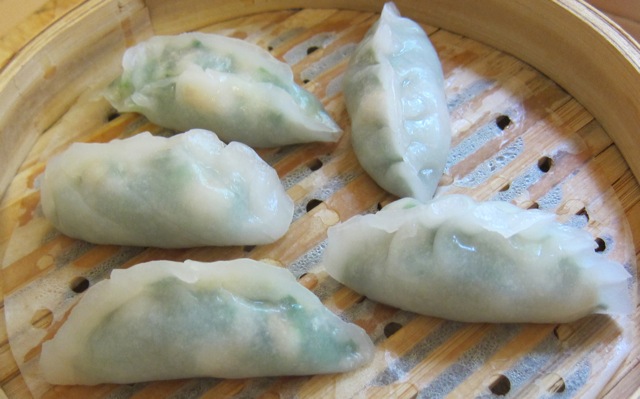
Here is another delicious mainstay of the tea ritual known as dim sum, and belongs to the class of dumplings enfolded with a wheat starch wrapper.  The name in Cantonese is Gao Choi Ha Gao 韭菜虾饺, or simply Gao Choi Gau (In Mandarin, Jiu Cai xia Bao).  You will find this steamed dumpling in almost every dim sum restaurant, although it will sometimes be formed into hockey-puck sized packets, and fried.  In either case you'll know it by the intensely green vegetable showing through the translucent wrapper.  

Like cilantro,  Chinese garlic chives,  jiu cai might strike some as an acquired taste.  Once accustomed to its sharp and fragrant flavor, however, it becomes an essential sensation for lovers of dim sum.

Filling

12 oz prawn, peeled and  deveined
12 oz garlic chives  
1 egg white
2 med clove garlic, minced 
1/4 rounded tsp white pepper
2 rounded tsp cornstarch
1 Tablespoon plus 1 tsp Shao Xing wine
1 tsp sesame oil
1 rounded tsp sugar
1 tsp salt

Wrapper:

1       Cup      wheat starch
1/2    Cup      tapioca Starch
1       Tab       Peanut oil
1/4    tsp         salt
1       Cup       boiling water

Dice half the prawns fine (appx 1/8"), and the other half large (appx 1/2") and set aside in a mixing bowl.  Garlic chives are sold in bundles at Chinese groceries, and known by the names  jiu cai  (Mandarin),  and gao choi (Cantonese); cut off 1 or 2 inches of the thickest (root) end, then chop into 1/2" sections.  On med heat, Stir fry in a wok or sauté pan until wilted, about a minute.  Allow to cool before adding to the prawns.
After adding the cooled chives to prawn,  combine the remaining filling ingredients and mix very thoroughly with a rubber spatula.  Refrigerate.

Sift the starches and salt into a mixing bowl; form a well in the powders, then add the oil.  Pour the boiling water, measured with a pre-heated measuring cup, into the well and stir quickly but carefully with a rubber spatula.  Scrape the sides as you mix, to incorporate all the ingredients.  Form a ball of dough.  As soon as you can handle the dough, knead it vigorously for a full 3 minutes, occasionally compressing the ball forcefully as you knead.  (Wheat starch dough is firm to the gentle touch, but extremely malleable).  This enthusiastic kneading is to insure that the starches and water and oil are smoothly and completely incorporated.  Divide the dough into 3 pieces and let it rest in a plastic bag for 10 minutes or so.  All the foregoing steps can be done ahead of time.

When ready to make dumplings, prepare your steamer with a parchment paper liner for the steamer tray—punch or cut 1/4” holes randomly in the paper to allow steam to pass through.  Alternatively, liberally oil the steamer tray or use vegetable leaf to ensure the wheat starch wrapper does not stick after steaming.  Allow the steamer water to boil, with the basket separate, ready to load dumplings.

Compress each ball of starch into a smooth, round shape and then roll on a flat surface to make a 1” dia.   Rope.  Put two ropes back in the plastic bag and cut the remaining into 1” segments.  To make the skins: working on a high density polyethylene cutting board, place a piece of 4” square piece of parchment paper over the segment and flatten it one at a time with rolling pin, Chinese cleaver, or tortilla press (works great), making sure the skin is a uniform thickness of between 1/16” and 1/8".  This disk will be slightly irregular in shape; you can proceed with making the dumplings and trim the excess with scissors if necessary, or cut the skin now to appx. 3-3/4"diam. (Traditionally, Gao Choi Gau is much larger than Ha Gau, which uses a circle 3-1/4" or less--) Use a cookie cutter, empty tin can or similar round object .  You can make the skins all at once, if they are kept covered with plastic or damp cloth at room temperature.  

The procedure for stuffing the dumplings can be the same as for pot stickers, but note that wheat starch dough is very delicate, and care must be taken not to puncture or tear the skins while filling.  (Dim Sum chefs occasionally vary the pleat design of dumplings, and you may want to experiment with your own method).

Place the dumplings in the lined steamer tray, but do not allow them to touch each other.  Put over the steamer, and cook for 6 to 7 minutes.  Serve in the steamer or place on a serving dish when cool enough to handle.  An accompanying dipping sauce is a nice touch, as is tea.


Siu Maaih Pork and Shrimp Dim Sum dumpling


Siu Maaih Pork and shrimp dumpling

There is no item that so epitomizes dim sum as this little morsel.  It will be served in every dim sum restaurant, no matter how humble the offerings.  Its name, Siu Maaih, which literally translated from Cantonese means "cook sell," might describe its humble beginnings as a street snack to go with tea, and therefore may have been dim sum's first dumpling.  Luckily for those of us who are willing to slave away in the kitchen making traditional Chinese delicacies, this one is relatively easy to produce.  One can make their own skins for siu maai, if one wants to destroy one's kitchen over the course of a very long day, but few cooks try it; the thin, factory made wrapper, available in every Chinese store, is inexpensive and foolproof.

2 small to medium shitake dried mushrooms
11 oz pork (picnic country rib boneless), minced (previously ground pork is acceptable)
6 oz shrimp, after shelling and deveining; 1/3 of this pureed or pounded, 2/3 should be chopped.
1 sm green onion, minced
1 Tab soy
2 tsp sugar
1/2 tsp salt
dash white pepper
3 tablespoons water

1 pkg  "thin shao mai" wrapper (i.e., Seattle's Rose brand)

Reconstitute the dried mushroom by submerging in very hot water for 1 hour.  Press out water, cut out stems, mince and set aside.

Prepare all other ingredients and combine, including the minced mushroom.  Mix vigorously in one direction for 3 or 4 minutes to make a uniform, cohered filling. 


With wrapper on flat of your left palm, wet edge of skin.  Using a small spatula or wide knife, slather approx. 2 Tab filling on wrapper.  Begin to close the palm, wrinkling the edges of the wrapper.  Close gently, gathering the edges together for pleating.  Pinch the wide pleats to make them more uniform.  Pressing in a bit more filling flattens the pleats and firms up the dumpling.  Applying some pressure to the bottom flattens the Siu Maaih and rounds the top.  Add a garnish of green onion, carrot slivers or 3 peas and they are ready to steam.


The dumplings can be frozen; I suggest you freeze them, separated, on a parchment lined tray before putting in a freezer bag to prevent sticking.

Steam 7 minutes if dumplings are fresh, 12 minutes if frozen.

makes approx. 24 dumplings


Guo Tie and Jiaozi (pot stickers and pork dumplings)


Pot Stickers  Guo Tie  and Jiaozi

This minutely detailed first recipe for pot stickers and jiaozi is only for those who, like myself, consider eating dumplings as something like a religious experience.

A few years ago in the United states, when asked to name a Chinese dish, most people would say, chow mein or lo mein.  The less savvy might have said chop suey, egg fu yung or egg rolls.  But today, the best known item on Chinese menus is probably pot stickers, or as they are known in Mandarin Chinese, guo tie.  These fried pork dumplings are so common that even grocery store delis have sad, damp heaps of them in warming pans, alongside roast chicken and kielbasa.  (In a more global sense one might think of dumplings as a gastronomical archetype, since stuffed doughs can be seen in just about every culture: raviolis, perogies, knishes, empanadas, samosas, knodels, vushka, pelmeni, Korean mandu...the list is endless) Less famous in the west is the steamed or boiled—and most likely original—version of this dumpling, jiaozi, which is a mainstay of Chinese cuisine.   In fact, jiaozi are at the heart and soul of Chinese culture.  No other food, with the exception of rice and noodles, has a more prominent place in the everyday lives of Chinese: they are a snack, a staple, a holiday treat, and an almost sacred ritual around the Lunar New Year.  During this time, making jiaozi is a social ritual as well, with family and friends gathering round the bowls of fillings and dough, rolling skins, stuffing the jiaozi and talking, until hundreds of the little morsels are ready for boiling.

There is no such thing as an “authentic” Chinese recipe, since within China there is no agreement on how any particular dish should be made.  In China, jiaozi and guo tie are made with beef or pork; they sometimes have fresh shrimp, dried shrimp or no shrimp at all; you’ll find dried mushrooms in some, but not in others; sometimes cabbage, sometimes not.  But in general, the tradition of these dumplings include the ingredients and methods outlined here.

As far as wrappers are concerned, acceptable factory made skins for making jiaozi and guo tie are available at all Asian groceries.  Also, home cooks can take the recipe below and process the skins with a pasta machine, cutting the sheets of dough with an appropriate sized circle cutter; however, the homemade, hand-rolled hot-water version is closest to the traditional Chinese method, and worth the effort in its superior texture: it will be substantial, flavorful and chewy.

About the meat: fatty cuts of meat are not demonized in China as they are in the west; traditional cooks will most often use ground pork belly, here commonly called fresh bacon.  On Chinese streets, you will find vendors selling ground pork for dumplings which is nearly white with fat.  In the present recipe, the cut of pork is optional, and a even lean meat will make an acceptable dumpling.

Filling:
  • 1 lb. Pork with fat (pork rib, pork shoulder, or pork belly)
  • 1 lb. Napa Cabbage
  • 2 green onions, white and green portion minced
  • 1 heap TAB minced ginger
  • 1 TAB Shao Xing rice wine or dry sherry
  • 2 TAB sesame oil
  • 1 TAB soy sauce
  • 1 round tsp salt, to taste.
  • 1 Heap TAB cornstarch
  • 1/4 to 3/4 cup Chicken or pork stock


Separate cabbage leaves and blanch in boiling water for about two and a half minutes. Allow to cool; meanwhile, chop the pork with a cleaver, rolling the mass and varying the direction of the chop: this is a matter of personal preference, since finer mincing produces a more tender, “grainy” homogenous filling, while a larger mince, say, 3/16” to 1/4” will be somewhat more firm and varied in texture.  I prefer the larger mince.  You can also put the pork through a meat grinder, using a quarter inch plate. Place chopped meat in a bowl. Wring out the water from the blanched cabbage using a kitchen towel, and chop to 1/4" to 1/2" pieces. Mix this together with meat and all remaining filling ingredients, adding cornstarch last.  Add chicken or pork stock slowly as you mix the filling in one direction.  Continue adding stock until mixture is visibly wet and "sloppy." If you've overdone the addition of liquid, and the fillng is impossible to handle when making the dumpling, add more cornstarch to firm it up. Keep in mind that the filling will firm up when it is refrigerated. Covered, the filling can be refrigerated for up to five days.  When you are ready to fill the dumplings, make one and boil it to test the flavor and texture, and making any adjustments at that time.

Wrappers:
Cold water can be used, but hot water dough produces a softer, more elastic dough, which is preferable in making most dumplings.
  • 1-1/4 lb bread flour, sifted.
  • 12 fl oz boiling water


When water just comes to a boil, slowly add it to the sifted flour and mix with chopsticks until a crumbled paste forms.  Knead the dough on a floured board as soon as it is cool enough to handle.  Add flour as necessary to form a soft, elastic dough which is not too sticky to handle.  Wrap with a damp cloth or plastic wrap and set aside to rest for about an hour.  Divide the dough in quarters, and roll each quarter into a rope approximately 1” in diameter.  Cut these into segments of about 5/8”, flatten with the palm, then roll out into a disk approximately 3” to 3-1/2” diameter, and 1/16” to 1/8” thick.
Keep all dough and rolled skins covered to prevent drying.  As I said, the skins can be purchased or the dough kneaded and rolled with a pasta machine, but texture and tradition will be sacrificed.

Making the dumplings:
The manipulation required for making jiaozi may appear daunting, but it is really very simple: essentially, the round disk of dough is folded with the filling inside, and the fold furthest from you is pleated as it is pressed to the fold closest to you, resulting in the traditional scalloped crescent-shaped packet.  Place a circle of dough flat in your left hand.  Moisten the edge all the way around with water, then using a spoon or chopsticks, place approximately a heaping tablespoon of filling in the center.  (If the dough is fresh and moist, the water may not be necessary.)  Fold the skin, and before the edges touch, grasp them with your right thumb and index finger, and beginning at the fold, pleat the outside edge, guiding the dough with your left fingers and press it to the inside (see photos).  As you do this from right to left, you will create a dumpling, which, when set aside on a piece of parchment paper or floured board, will form a flat side perfect for browning when making potstickers.  With a little practice, this process will become second nature.  Note that if you are making boiled jiaozi the dumpling must be sealed very securely to prevent the water from seeping into the jiaozi while cooking.
The dumplings can be frozen if desired—arrange them without touching each other on a piece of parchment paper or floured tray and place in freezer until the surface of the dumpling is very firm and dry to the touch.  You can then put them together in a plastic bag and remove as many as needed in the future.


Dipping Sauce:
Dipping sauce for dumplings is traditional in China, and will usually appear served with potstickers and jiaozi in Western Chinese restaurants.  Often, only vinegar is used, especially the famous, dark Qing Kiang vinegar.  But all sorts of variations exists; the sauce below is a sweet version:
  • 1/2 cup soy sauce
  • 1/4 cup sweet soy
  • 2 Tab Shao Xing wine or dry sherry
  • 2 Tab rice vinegar, or Qing Kiang vinegar
  • 1-1/2 Tab finely minced ginger, steeped in 1/4 cup hot water for 30 min.
Cooking Guo Tie (potstickers):

Pre-heat a flat bottomed, well-seasoned pan or skillet on medium heat; add peanut oil to a depth of approximately 1/16 inch.  Arrange guo tie close together with the flat side of the dumpling in the oil.  Cover and cook for about 3 minutes; after a couple of minutes, lift one or two of the dumplings to see how the browning is progressing. Add water to a depth of about 1/8”—be careful, this will spatter.  Cover again and turn heat down to low or medium low, for about 4 minutes.  After the potstickers are well steamed, uncover and cook for another two minutes, to evaporate any remaining water and to re-crisp the dumplings. Remove dumplings to a platter, and serve with browned sides facing up.

Cooking Jiaozi (boiled dumplings):
One traditional method for cooking jiaozi calls for adding the dumplings to boiling water, then re-boiling after three more additions of  cold water.  However, this causes the cooking time to vary according to the quantity of water, number of dumplings, and size of pot.  I prefer the simpler method of straightforward boiling, depending on the size of the jiaozi.
In a large pot or kettle full of boiling water on high heat, add dumplings and immediately stir very gently to prevent them sticking to the bottom.  Once the water is boiling fully, turn heat to med/med high, and boil for 4 to 6 minutes.  As always, it is recommended that you test the dumpling to make certain it is done.
If you are boiling or frying frozen dumplings, add approximately 1 minute to the cooking time.
Drain and serve in a shallow bowl or platter.  Garnish with sesame oil and minced onion green if desired, although in China jiaozi is generally served without adornment.

Chi You Chao Mian (Soy Sauce Chow Mein)


Chi You Chao Mian (Soy Sauce Chow Mein)

One of the lesser known items enjoyed at Chinese dim sum restaurants is a chewy, savory noodle dish known in English as Soy Sauce Chow Mein.  This is not usually seen on the ordinary steam carts circling the dim sum restaurant; instead, you'll find it on a cold cart featuring other specials, such as salt-and-pepper squid, roast duck, steamed greens with oyster sauce, etc.  Its unique texture and flavor requires a thin steamed wheat noodle, often labeled  won ton noodle,  beansprouts, green and white onion, and soy sauce, all stir fried to perfection.  The Hong Kong style "won ton" noodles can be purchased fresh at most Asian groceries; however, it is essential to use the steamed version, which isn't always labeled as such, but you can also buy the raw noodle, and steam it yourself in a bamboo steamer: spread the noodles out in a steamer tray 1" to 2" thick, and steam for approx 7 minutes.   As soon as they are cool enough to handle, separate and fluff the noodles and set aside.

8 oz  thin steamed Chow Mein Noodles,  aka: "won ton noodles" (i.e. Wan Hua Foods brand) 
3/4 med yellow onion
2 or 3 green onion
7 oz beansprouts
3 Tab Soy sauce
1/2 tsp salt
2 rounded tsp sugar
Dash of vinegar
Dash of dry white sherry, or XiaoShing wine...
Sesame oil

Submerge steamed noodles in hot (150 degree) water for 2 minutes.  Drain well.

Cut yellow onion into tapered slivers, about 1/2 " wide.  Cut green onion into 1-1/2" sections; slice the white portions in half and break apart.  Mix soy with sugar and dash of vinegar and set aside.

Heat 3 Tablespoons of peanut oil in a wok, until just beginning to smoke, and add yellow and white portion if green onion.  Gently flatten the onions to the wok with the shovel, allowing to brown for 20 seconds or so; add beansprouts, green onion pieces, and a dash of wine, then stir-fry for 1 to 2 minutes, till the sprouts just begin to soften.  Add steamed noodles and soy sauce/sugar mixture; it's a good idea to chop into the mass of noodles with the spatula 2 or 3 times to shorten them, then toss until sauce is thoroughly incorporated and the noodles are hot.  Serve on oval platter and garnish with sesame oil.

Dan Dan Mian (Dan Dan Noodles)


Dan Dan Mian (Dan Dan Noodles)

The name of this dish derives from the verb dan, to carry on a pole, referring to the time, until recently, when Sichuanese street vendors carried the makings for snack noodles on bamboo poles and called out their offerings,"dan dan mian!". Among devotees of this dish there is much discussion with regards to the addition or omission of sesame paste. It's worth noting the difference, since sesame paste is intensely flavorful and the two versions would seem to be at odds within the tradition of dan dan mian. The fact is, both are common in Sichuan, though the exported version of Dan Dan Mian seems to always contain the sesame paste. Common elements to look for are pork, chili oil, scallion and ya cai, (preserved vegetable), and sichuan peppercorn (Hua Jiao)--the latter being included in countless traditional Sichuan preparations. In my time in Chengdu, the capitol of Sichuan province, I enjoyed this snack many times in the small restaurants that one found in the side streets of that city.

12 oz fresh wheat noodles
4 oz pork, minced
3/4 tsp Sichuan peppercorn, lightly roasted and ground
1 med clove garlic, minced
1-1/2 Tab Sichuan pickled vegetable ya cai (editor: Tianjin preserved vegetable works well)1 Tab soy sauce
1 Tab rice wine

Sauce/topping:

2 tsp dark soy sauce
1 Tab Soy sauce
1 Tab chicken stock
1 tsp ChingKiang black vinegar
1/2 tsp sugar
2 Tab chili oil
1/4 tsp of salt

2 scallions, green portion only, sliced thin--reserve a few for garnish
Cook the fresh noodles for 2 minutes or so, and check for desired doneness. Remove, drain until the noodles begin to stick together, then toss with a small amount of oil; portion out to 2 or 3 bowls.
Combine the sauce ingredients.
Heat the wok on medium heat until it just begins to smoke and add 3 or 4 tablespoons of oil. When the oil is hot, add minced pork and stir fry, taking care to break up the meat; quickly add the garlic, peppercorn and preserved vegetable and toss. Splash in a tablespoon each of soy sauce and rice wine, toss, and remove.
Portion out the sauce/topping equally over each bowl of noodles; garnish with sesame oil and a few slices of green scallion

To make the sesame paste version: use the recipe above, omitting the Chingkiang vinegar and dark soy sauce. Also, to the sauce/topping ingredients, add 1 round Tablespoon of sesame paste and another tablespoon of chicken stock, and mix very thoroughly to dissolve the sesame paste.

Ha Gao (Shrimp Dumpling)


Ha Gao  (Shrimp Dumpling)

Ha Gao (Cantonese, also Romanized as Ha Gow, Har Gow or Ha Gau, meaning “Shrimp Dumpling”) is possibly the most classic dim sum delicacy, seen in every dim sum restaurant on earth, no matter how limited the menu.  It works excellently as an appetizer for a Western meal, however, in China it is exclusively a dim sum item or a street snack sold alongside other dim sum favorites.  When done well, Ha Gau has a spectacular appearance as well as taste.  Wheat starch is the key ingredient for the skin, and its sticky texture and semi-transparency, while very unusual to western tastes, is ubiquitous in Southern China and Southeast Asia.  When making this snack, you might find that handling the wheat starch wrapper for these dumplings is a challenge. The dough trades off its finished beauty with being sticky and structurally weak to work with. Having said that, because it has no gluten, the dough actually becomes easier to manipulate than wheat flour once you get used to it. I’ve tried to photograph the process in the hopes that this will help.  In any event, the effort will be rewarded...

Filling:
1       oz         Pork Fat, finely diced (Optional...)
10     oz         deveined and shelled shrimp
1       oz         bamboo shoots, rinsed, drained well, chopped fine.
1       egg       white only, lightly beaten
1       tsp         sugar
1/2    Tab       cornstarch
1/2    tsp         salt
1/2    tsp         sherry
1/2    tsp         sesame oil
Dash    white pepper
Finely mince and pound or puree 1/2 of the shrimp.  With the other half, cut the shrimp into 3 or 4 large segments, depending on the size.  (For appearance and texture, you want large pieces of shrimp in the filling; the finely minced provides an overall binder.)   In a bowl, mix the shrimp and beaten egg white thoroughly.  Add minced pork fat, bamboo shoots, sesame oil, salt, white pepper, sherry and cornstarch.  Mix thoroughly with a rubber spatula.  Refrigerate while you make the skins.

Skins:

1       Cup      wheat starch
1/4    Cup      tapioca Starch
1       Tab       Peanut oil
1/4    tsp         salt
1       Cup       boiling water
Sift the starches and salt into a bowl; form a well in the powders, then add the oil.  Pour the boiling water, measured with a pre-heated measuring cup, into the well and stir quickly with a rubber spatula.  Scrape the sides as you mix, to incorporate all the ingredients.  Form a ball of dough.  As soon as you can handle the dough, knead it vigorously for a full 3 minutes, occasionally compressing the ball forcefully as you knead.  Wheat starch dough is firm to the gentle touch, but extremely malleable.  This enthusiastic kneading is to insure that the starches and water and oil are smoothly and completely incorporated.  Divide the dough into 4 pieces and let it rest in a plastic bag for 6 minutes.  In the meantime, make certain your steamer water is boiling.  Prepare a parchment paper liner for the steamer tray—punch or cut 1/4” holes randomly in the paper to allow steam to pass through.

Compress each ball into a smooth, round shape and then roll on a flat surface to make a 3/4”to 1” dia.   Rope.  Put three back in the plastic bag and cut the remaining into 3/4” to 1” segments.  To make the skins: working on a high density polyethylene cutting board, place a piece of 4” square piece of parchment paper over the segment and flatten it one at a time with rolling pin, Chinese cleaver, or tortilla press (works great), making sure the skin is a uniform thickness of between 1/16” and 3/16”  This disk will be slightly irregular in shape; you can proceed with making the dumplings and trim the excess with scissors if necessary, or cut the skin now to appx. 3-1/4” diam. using a cookie cutter, empty tin can or similar round object(An empty 6-1/2 oz.  tuna can works very well).  You can make the skins all at once, if they are kept covered with plastic or damp cloth at room temperature.
Pick up the skin very gently (these wrappers are soft and tear easily—even if you nick it with a fingernail, this will likely produce a tear in the dumpling as it steams) put a rounded tablespoon of filling in the middle, fold the skin patially around the filling to form a trough; hold this loosely in the fingers of your left hand, with the thumb resting in the middle, over the filling.   Gently pleat the side furthest from you only, from right to left, using the left thumb and right index finger to guide the pleats against the side closest to you, while the right thumb provides backing.  Pleat along the dumpling, until the dumpling is enclosed.   You need not tightly seal the wrapper as you pleat—the concern at this point is not to stress the wrapper resulting in a tear.  Once it’s pleated, you can press the edges, sealing the dumpling and cutting off the excess if the wrapper wasn’t pre-cut.  Place as many dumplings as you can (without touching) on the paper-lined steamer tray. It is best to use all the wrapper dough right away; it works best when still warm.


Steam the dumplings for 5 minutes.  If it is necessary to take the dumplings out of the steamer tray—as opposed to setting out the tray as a serving dish—you should wait 3 or 4 
minutes while the skins cool somewhat; they are very soft and sticky while piping hot.


If absolutely necessary, these dumplings can be frozen once they are steamed, but they lose about 15% of their texture.  Thaw them on parchment paper or polyethylene cutting board before reheating, and steam for about 3 minutes as before


Fun Gwor (Pork and Shrimp Dumpling)


Fun Gwor (Pork and Shrimp Dumpling)

This is another classic dim sum tidbit. One might want to refer to the recipe for Ha Gao, with its detailed description of wheat starch dough, as this dumpling uses the same wrapper. 

There can be confusion, even among native speakers, about the exact names of Chinese things, and food items are no exception.  The Cantonese “Fun” in the name is often mistakenly translated as “rice flour,” mistaken because there is no rice flour used in this recipe. The literal translation of “Fun (mandarin: Fen) can mean any number of things, but it most likely attaches to the meanings of powder and flour, especially bean and potato starch flours, which likely have been used in the past instead of wheat starch.  “Gwor” (guo) means fruit, and poetically alludes to its crescent shape, suggesting a section of fruit, or the delicacy of fruit.
8 oz Pork, minced 1/8” to 1/4”
4 oz peeled deveined shrimp, minced per pork
2 dried shitake mushrooms, minced per pork
7 peeled water chestnuts, minced per pork
1 heap tsp garlic, minced med fine
1 scallion, minced med.
Stir-fry this mixture just until pork has cooked through—turn off the heat, then immediately add mixture of:
1/4 cup chicken stock
1 Tab cornstarch
1 Tab wine
2 Tab oyster sauce
1 tsp Kosher salt
2 tsp sugar
1 Tab soy sauce
1 scant teaspoon sesame oil
When the mixture has cooled, add:
1/4 tsp white pepper
2 tsp sesame oil
1/4 heap cup (loosely measured) chopped cilantro and stems
Mix and refrigerate, preferably overnight,.
To make dumplings, follow recipe and procedure for the wheat starch dough used for Ha Gau skins (1 cup wheat starch; 1/4 cup Tapioca Flour, 1 Tab oil, salt and 1 cup water.); place appx 1 rounded Tab of filling on the skin, fold over and press edge gently to seal and form a crescent.  Steam for 5 minutes.  Allow to cool for 2 or 3 minutes before serving or transferring to serving platter (serving in steamer tray is recommended, since the hot dumplings are very sticky and fragile).

Deep-frying this dumpling produces a nice variation.  Remembering that the filling is already cooked, the dumpling can be fried at 325° to 350° in peanut oil for 1 or 2 minutes until crisp.